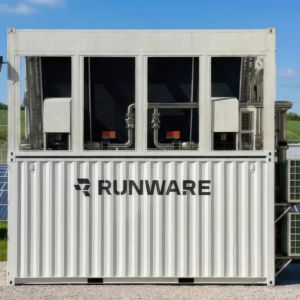
Runware aims to build AI data centers similar to automobiles, where finished products can be seen rolling off the production line. CEO Flaviu Radulescu reportedly said that the company’s plan is to produce 30 megawatts of data center capacity per day by the year 2028. The other expectation is to bring every pod online within a span of 48 hours at a location with power supply and connectivity facilities. However, those achievements are yet to be proven on a larger scale. What makes this approach attractive is the speed of production and commissioning. The idea of Runware is to build and test the pods in the factory before delivering them for commissioning. It allows us to cut back on the amount of work done on site. But achieving these objectives in a timely manner and at lower costs is yet another problem to be tackled. Pods coming off a line, like cars Runware’s modular AI data center, the Sonic Pod , is 20 feet long and contains about 1,200 graphics processing units. Each unit provides 1 megawatt of computing power. The closed-loop liquid cooling system needs no permanent water connection. Runware already assembles these modular data centers in Romania and expects the second factory to open by early 2027. Presently, it takes about three weeks to build one Sonic Pod. According to CEO Flaviu Radulescu, it could drop to a day with an assembly line. The 48-hour target refers to something else entirely: that is, fabrication or grid access is not included; instead, it encompasses the installation and setup of a finished pod at an already prepared site. Runware expects a surge in customer demand to propel its growth strategy. The company claims it has secured $1 billion in committed interest, which represents in excess of 20 megawatts of capacity. However, this interest has yet to be converted into completed sales. The company said on October 30 that mass production is projected to begin in late 2027. Nvidia’s standard, Crusoe’s factory, Runware’s inference bet Runware isn’t the only company seeking to accelerate data-center construction. On October 21, Nvidia revealed the DSX POD , which is a reference design for ready-made Vera Rubin systems. The units are assembled and tested before being shipped to buyers. Nvidia claims that the installation at prepared sites only takes two weeks instead of six months required with conventional methods. Crusoe is one of those partners. Its Spark platform connects a 352,000-square-foot Colorado factory with Crusoe Cloud. The company has operated modular facilities since 2020. It says it can deliver productive AI capacity in as little as three months. However, the timelines measure different stages. Runware’s 48 hours covers setup, Nvidia’s 14 days covers deployment, and Crusoe’s three months covers working capacity. Runware’s business model differs, too. It sells inference services rather than data-center space. Customers can supply their own GPUs, although Runware still relies on Nvidia for networking. Runware vs Nvidia DSX POD vs Crusoe: AI Modular Data Center Deployment Compared A $75.8 billion market with hard limits The pressure to increase the speed of manufacturing modular data centers comes after an increase in demand for them. According to Grand View Research, the value of this market was around $29 billion in 2024 and could reach $75.8 billion by 2030, which means a 17.4% annual growth rate. According to JLL, total global data-center capacity could reach 200 gigawatts by 2030, requiring almost $3 trillion in investments. The same company predicts that inference will become more popular than training starting from 2027. In Japan , JERA, Dell, and RHAELM are planning a repeatable design for a $15 billion, 400-megawatt project. But faster construction won’t solve the industry’s power problems. JLL says grid-connection waits in major markets exceed four years. Meanwhile, the IEA expects data centers to consume 950 terawatt-hours of electricity by 2030. Public opposition adds another challenge. Pew found 54% of Americans consider data centers bad for the environment, up from 39% in January. Texas paused grid approvals for projects under review in August and halted environmental permits in September. Manufacturing has its own set of risks. According to TechCrunch , the electric vehicle startup Arrival had difficulty in making mass production a profitable endeavor. Runware is now undergoing a similar challenge: proving whether its assembly line can perform at the speed and scale it claims. If you're reading this, you’re already ahead. Stay there with our newsletter .