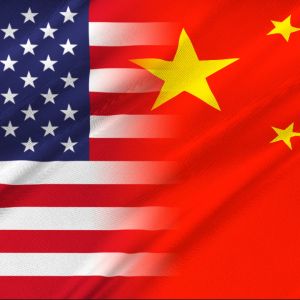
John Pearce, the Chief Investment Officer at UniSuper, has warned that China could overtake U.S. tech giants in the AI industry. The warning comes as China attempts to wean itself off U.S. technology despite challenges from the complicated relationship between U.S. tech and Chinese industries. The production of cheaper and increasingly capable artificial intelligence (AI) tools from China is sparking concerns about the stability of U.S. technology markets and the future of American leadership in tech innovation. At the Bloomberg Forum for Investment Management in Sydney on Wednesday, John Pearce, Chief Investment Officer at UniSuper, a A$158 billion ($104 billion) Australian pension fund, warned that Chinese progress in AI could cause a sudden sell-off among U.S. tech giants. “If they’re developing their LLMs and doing it much, much cheaper than the Americans and still giving the same output, well that’s going to put a big question mark on your business model,” Pearce said. He described the possibility of more “ DeepSeek moments ” as an immediate threat to U.S. firms such as Microsoft, Nvidia, and Apple. These are companies that all exceed $4 trillion in market value. China’s AI surge raises concerns over U.S. tech dominance Prior to Pearce’s warning , concerns were rising over inflated valuations of AI-related equities. Many of these companies are still at the early proof-of-concept stage, very similar to the tech bubble of the early 2000s. However, Nvidia’s CEO Jensen Huang dismissed these concerns, saying that his company’s newest chips are on track to generate up to half a trillion dollars in sales. Huang believes that maintaining U.S. leadership in AI requires “finesse” and long-term thinking, especially when navigating delicate trade relations. “The policy that causes America to lose half of the world’s developers is not beneficial long-term,” Huang said during a company conference in Washington. He warned that harsh export controls could push global developers toward Chinese platforms. Despite these tensions, Huang thinks of the Chinese market as important for U.S. technology companies. The country has put efforts into limiting its engagement with U.S. technology, but efficiency is hard to quit. “Their industries would like to be as productive as possible,” he said. “American technology is the best, and when it’s the best, it’s also the most affordable.” China dominates science collaborations and education Alongside its efforts in the AI industry, China has been steadily expanding its dominance in global scientific research. A new study published in the Proceedings of the National Academy of Sciences found that Chinese scientists now lead almost half of all collaborative research projects with U.S. counterparts. This figure is up from just 30% in 2010. The analysis of nearly six million papers revealed that Chinese-based researchers held 45% of leadership roles in U.S.-China joint studies in 2023. At the current pace, China is expected to reach full parity with the U.S. by 2027 or 2028. Researchers from Wuhan University, UCLA, and the University of Chicago used machine-learning models to track which scientists led what projects. This provided a more detailed picture of who had more influence or control in the collaborations than traditional citation or publication counts could. China’s increased interest in global research is filling a gap left by the deep funding cuts and layoffs across federal science agencies under President Donald Trump’s administration in the U.S. Trump’s funding cuts have triggered an exodus of American researchers. Countries such as Canada and Denmark have since introduced programs to attract these scientists, accelerating the redistribution of global research power. Chinese researchers are projected to achieve leadership parity in 8 of the 11 critical technology sectors identified by the US National Science Foundation, including AI, semiconductors, and materials science, before 2030. Since 2012, China has invested over 33 billion yuan ($4.7 billion) to educate students mostly from Africa and South Asia, through its Belt and Road Initiative. By 2018, almost half of all international students in China came from these regions, and many of them are now collaborating with Chinese scientists on global projects. Get seen where it counts. Advertise in Cryptopolitan Research and reach crypto’s sharpest investors and builders.